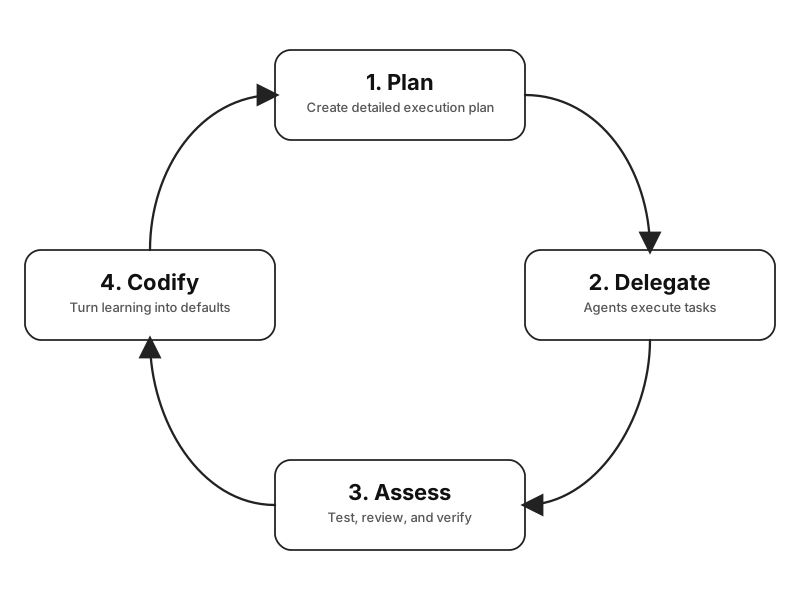
Dan Shipper (Every) describes compounding engineering as an AI-native way of building software where each shipped feature makes the next feature easier (not harder).
The loop: Plan → Delegate → Assess → Codify
(Also phrased as Plan → Work → Review → Compound in Every’s write-up. “Codify” is the “Compound” step.)
Core Idea
Treat process knowledge as a first-class artifact. The code is not the only output—your prompts, templates, checks, and conventions should improve with every iteration.
Heuristic: If you did not codify, you only shipped code once. If you codify, you shipped capability.
Note on AI assistance: While the “Delegate” step explicitly hands tasks to autonomous agents, AI assistants can be valuable collaborators throughout all stages—helping draft plans, review code, suggest codifications, or refine templates. Delegation to an agent is just one form of AI-assisted work in this loop.
The Loop
1. Plan
Create a plan detailed enough that an agent can execute it:
- Goal, scope, non-goals
- Constraints (security, performance, UX, compatibility)
- Acceptance criteria (definition of done)
- Where to change things (files/components) and repo conventions
- Test plan (what proves it works)
Output: a plan you can reuse as a template.
2. Delegate
Delegate execution to one or more agents:
- Implementation, refactors, investigations, tests, docs
- Keep tasks chunked into reviewable units (diff/PR-sized)
Output: code + tests + notes.
3. Assess
Verify correctness and fit:
- Run tests, lint/typecheck, build
- Manual product checks where needed
- Review against acceptance criteria
- Optional: agent-based review as a second pass
Output: confirmed result + a short list of issues/surprises.
4. Codify (the compounding step)
Do a short reflection and encode what you learned so the next cycle is faster and safer.
Codify into:
- Repo rules / agent instructions (how we do X here)
- Reusable prompts, slash commands, sub-agents
- Templates (plan template, PR template, investigation template)
- Guardrails (tests, linters, CI checks, invariants)
- “Known pitfalls” + how to detect them
Output: better defaults for both humans and agents.
5-Minute Codify Checklist
After shipping, answer and encode:
- What confused the agent or us?
- What instruction would have prevented the first mistake?
- What automated check/test would catch this earlier next time?
- What pattern/component/template should become the default?
- Where should this live so it gets reused automatically? (rules, prompts, CI, docs)
References
Primary Sources (Shipper / Every)
- Shipper, Dan. “Dispatch from the Future: building an AI-native Company”. YouTube.
- Shipper, Dan. “Compound Engineering: How Every Codes With Agents”. Every.
- Klaassen, Kieran. “My AI Had Already Fixed the Code Before I Saw It”. Every.
- compound-engineering-plugin. GitHub, EveryInc.
Related Prior Work
The Plan-Delegate-Assess-Codify pattern maps to established continuous improvement loops:
PDCA / PDSA cycles (Plan-Do-Check-Act / Plan-Do-Study-Act):
- PDCA Cycle (Plan-Do-Check-Act). ASQ.
- PDSA Cycle (Plan-Do-Study-Act). Deming Institute.
Mapping: Plan ≈ Plan, Delegate/Work ≈ Do, Assess/Review ≈ Check/Study, Codify/Compound ≈ Act (standardize + feed learning forward).
Agile retrospectives (“inspect and adapt”):
- The Scrum Guide. Scrum Team events and adaptation.
After Action Reviews (structured learning after execution):
- FM 7-0 Appendix K: After Action Reviews (AAR). U.S. Army.
Improvement Kata (scientific thinking as a practiced loop):
- Rother, Mike. The Improvement Kata.