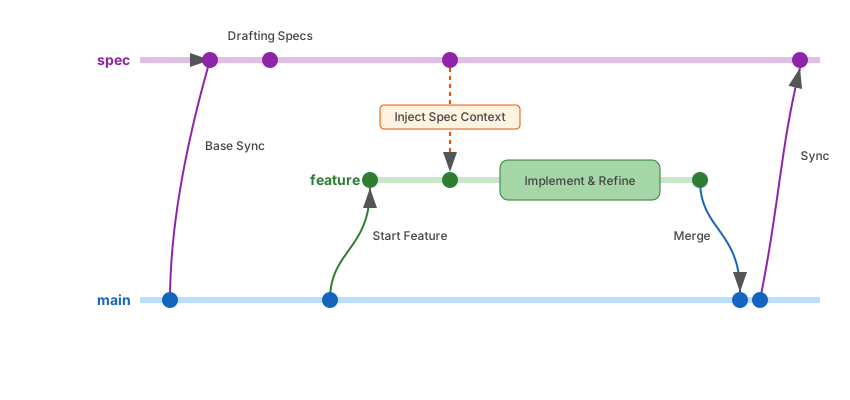
Spec Branch Flow is a branching strategy designed to keep the main codebase clean while allowing for messy, iterative exploration of specifications, PRDs, and documentation in a parallel track.
The Problem
Developing specifications (PRDs, design docs, rough notes) often involves rapid iteration, drafting, and “pollution” that shouldn’t necessarily clutter the clean history of the main branch. Creating a new branch for every small spec change creates overhead, yet keeping them out of the repo makes them harder to reference during coding.
The Solution: A Parallel Spec Branch
We maintain a long-lived branch named spec (or similar).
- Pollution-Free Main: The
mainbranch remains pristine, containing only production-ready code. - Messy Spec Branch: The
specbranch contains everything inmainplus the working drafts, experiments, and active specifications. - One-Way Sync: We regularly merge
mainintospecto keep the specs compatible with the latest code. We never merge the entirespecbranch back intomain.
The Workflow
- Drafting: Write and iterate on specs in the
specbranch. - Feature Start: When ready to implement a feature, create a
featurebranch frommain(as usual). - Inject Spec: Bring the relevant spec into your working context.
- Command:
git checkout spec -- path/to/spec.md - AI Assistant Role: Ask the AI to “Bring the spec for feature X,” and it handles the checkout.
- Command:
- Implementation & Refinement: Work on the code in the
featurebranch.- Crucial Step: As you discover inconsistencies between the spec and reality (technical constraints, edge cases), update the spec file directly in the feature branch.
- This ensures the spec evolves from “what we thought we wanted” to “what we actually built.”
- Merge to Main: Merge the
featurebranch intomainincluding the updated spec file.- This converts the spec from a “draft” into “system documentation.”
- Loop: Irregularly sync
mainback intospecso thespecbranch inherits the finalized, reality-tested documentation.
Advantages
- Automatic Documentation: By merging the spec,
mainalways contains documentation that reflects the actual implementation, not just the initial wish-list. - Efficiency: Fixing specs in flight prevents the “stale documentation” problem without requiring context switching back to the
specbranch during coding. - Context Injection: AI agents can easily pull context from the
specbranch without user intervention. - Separation of Concerns: Humans can “think” in the
specbranch and “build” in thefeaturebranch.
Flexibility
This flow is a guideline, not a strict rule.
- If a spec is purely ephemeral (e.g., a rough brainstorm), you might choose not to commit it.
- If a spec covers multiple features, you might check it out, partially implement it, and only commit the relevant sections.
- Teams should adjust the “strictness” of the main-to-spec sync based on their cadence.
Related Links
- Separate Discovery from Delivery: Explains the rationale for decoupling experimentation and requirement gathering from the actual implementation phase.
- Spec-Driven Development: The foundational philosophy that treats specifications as the primary source of truth for AI agents.
- Executable Specs: Explores how these synced specs can evolve into automated test suites or verification scripts.